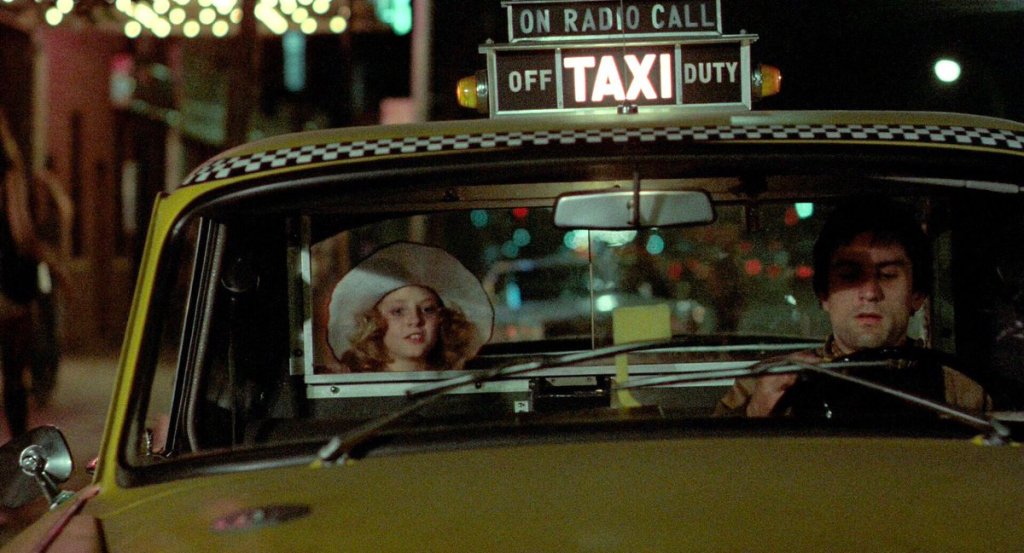
The first time I watched Taxi Driver (1976), I did it in true Midnight Culture fashion; with a plate of chicken nuggets and chips at one in the morning. It was the Summer of 2013 (which has absolutely no ring to it) and I was going through a phase where I would stay up until it started to get light outside, watching films. I would fully indulge in the flipped approach of a summer holiday, sleeping all day and staying up all night, letting the movies I was watching mingle with my dreams. This is when I discovered there are certain movies that just hit differently at one in the morning and they usually involve a shoot-out, characters that exist on the fringes of society and a grimy depiction of city life. Taxi Driver has all this and more.
Directed by Martin Scorsese and starring Robert De Niro, Jodie Foster and Cybil Shepherd, Taxi Driver is held up as a piece of cinematic mastery, often cited as one of the greatest movies of all time. Every frame and creative choice has been analysed, the trivia has been revealed and De Niro’s method choices have been discussed at length, so I am not going to spend time going into those aspects of the film, but would highly recommend typing ‘Taxi Driver Analysis’ into YouTube for a selection of video essays. Instead, I am going to talk about how this film was one of the starting points in the Midnight Culture philosophy and what it is about this film that makes it so much more watchable after midnight.
The film follows protagonist, Travis Bicknell, a Vietnam veteran who starts doing night shifts as a taxi driver because he has insomnia. Unlike other taxi drivers he’ll go anywhere in the city including Harlem and The Bronx, which were notorious at the time. Travis doesn’t care; he’s disillusioned and isolated, existing on the edge of society. He struggles to communicate clearly with other people but through his diary entry voiceovers we see how his perspective and mental state spirals into paranoid, obsessive fantasies.
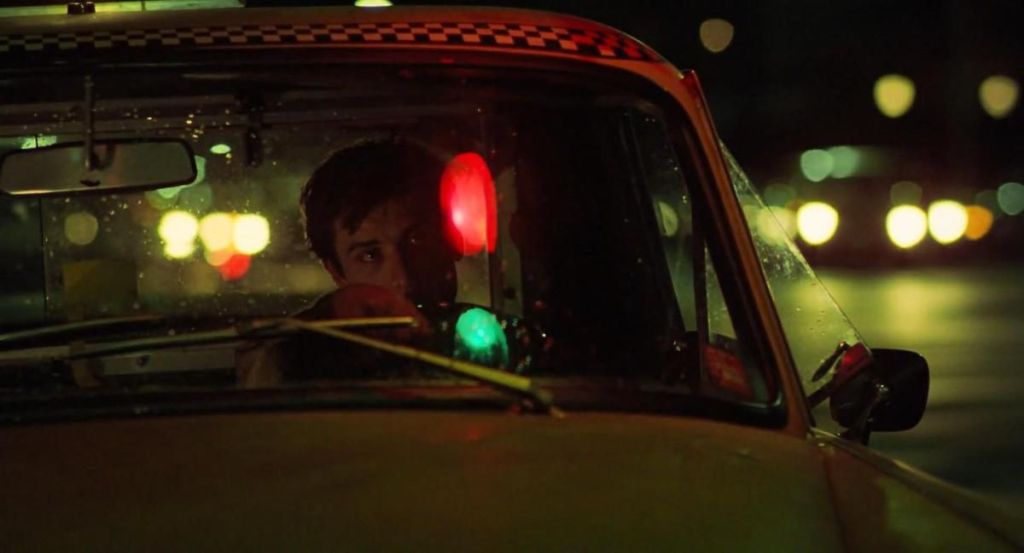
Travis’ taxi picks up a kaleidoscope of characters from the cross-section of the city and from the cab windscreen we see the grubby, city streets of 70’s New York. I love the neon lights, the colours of the opening sequence and there is a gorgeous shot of De Niro at the wheel of the taxi while traffic lights turn from red to green. The film is grounded in a few facts and interactions: the first date with Betsy (Cybil Shepherd), the meeting with Iris (Jodie Foster) at a cafe and fictional candidate, Senator Palantine running for President. Everything else feels like a fever dream, scenes and interactions that are short, yet somehow meandering. I have seen the film so many times and feel like I uncover something new every single time I watch it.
The City
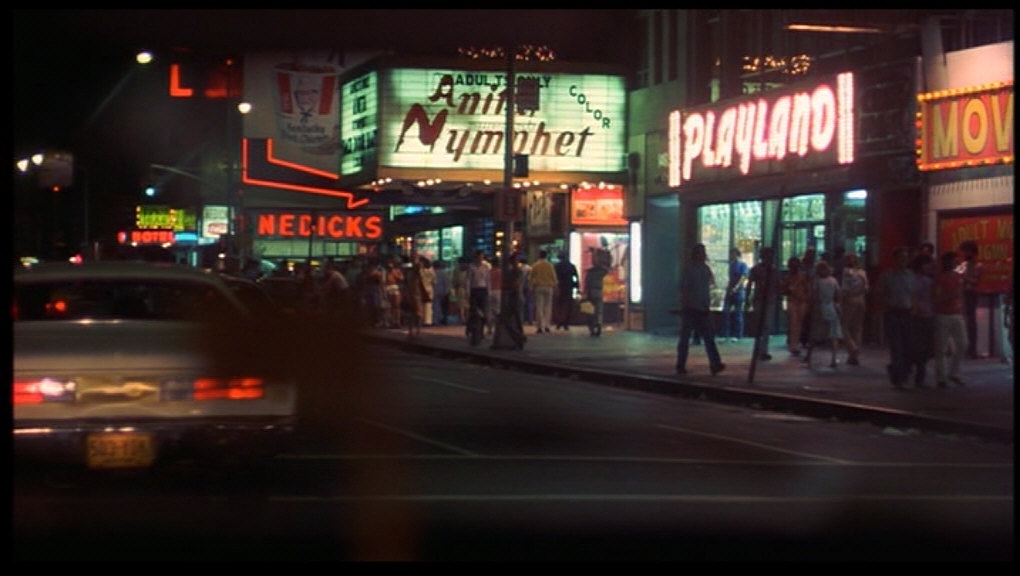
Taxi Driver was shot on location in New York City in the summer of 1975. This was during the sanitation worker’s strike which meant bags of rubbish were piling up on the streets, and in the West Side of the city where much of the filming took place the buildings were derelict and crumbling around the crew. This gives the film a time capsule quality, enhanced by the shots of the city from the perspective of Travis’ windscreen. The rubbish, the crowds, the grainy neon lights on film all feed into Travis’ manifesto that ‘all the scum and dirt needs to be cleaned from the streets’ and it is shown beautifully.
The Script
Written by Paul Schrader who went on to write a series of late-night, street-life movies called ‘The Night Worker Series’. These include bookend films: Taxi Driver and Light Sleeper, and American Gigolo and The Walker. Like Travis says in Taxi Driver, ‘All the animals come out at night,’ and Schrader’s work continuously comes back to these late-night themes: insomnia, loneliness and existing on the fringes of conventional society. In Taxi Driver the scenes with dialogue are sparse and many of the scenes are driven by a combination of the score and Travis’ diary voice over, which becomes more intense and paranoid as his feelings of isolation increase.
Travis and Betsy
In the first third of the film we meet Travis’ love interest, Betsy. Travis comes into Palantine’s campaign office where Betsy works and asks if she would like to come and have some coffee and pie with him? Travis then delivers my favourite diary entry/ text in the whole movie:
‘We went to a coffee shop on Columbus Circle. I had black coffee and apple pie with a slice of yellow cheese. I thought that was a good selection. Betsy had coffee and a fruit salad dish but she could have had anything she wanted.’
Travis bicknell, Taxi Driver
As someone who loves food and food narratives, I love this moment of detail and how much we can deduce about the characters from their order. Travis goes for the all-American apple pie, trying to maintain this image of normalcy. Betsy is a basic bitch. Let’s be honest, if the movie was made today she would live for a bottomless brunch and have a grey velvet house. So of course she is having a fruit salad. The dialogue delivered by Cybil Shepherd in this scene is so beautifully spare and hinges on her reactions to Travis’ increasingly personal questions and assessments. He tells her that he can see she is lonely and that her close male colleague’s energy is ‘in all the wrong places’. He goes from seemingly normal, to intimidatingly personal and yet Betsy is enamoured.
Betsy and Travis’ relationship goes tits up (or tits out) when he takes her to an X-rated movie. Paul Schrader has talked about this in interviews suggesting that Travis does this under the guise of naivety but is actually trying to show her the dirt of the world that plagues him, and to reveal that he is not this all-American pie eating man, but rather that he has darkness and dirt on him too. Betsy is appalled but after all this is a man who told you he noticed your intrinsic loneliness after only watching you through a window… the signs were there, Betsy!
Travis and the Travelling Salesman
Another great scene and performance is the scene with the travelling salesman who sells Travis a set of guns. Now it is unclear how many of the asides were written and how much was ad libbed by actor, Steven Prince but this is a masterclass in how to draw a clear character in three minutes of screen time. The character refers to the guns as, ‘little beauties’ and at one point (and my personal favourite) says ‘aint’ that a little honey,’ in reference to a .380 gun. He loves his stock, I love his enthusiasm, I could watch that scene again and again.
Content warning: Racist Language
The Score
I couldn’t talk about Taxi Driver and not talk about the score. The score composed by Bernard Hermann is fantastic. It is so atmospheric, each rolling drumbeat reminding us that Travis’ mental state is steadily unravelling. The saxophone theme brings a sense of optimism and the brass sounds almost like sirens. The soundtrack is all on Spotify and you can even find some pieces on hourly loops on YouTube.
Jodie Foster
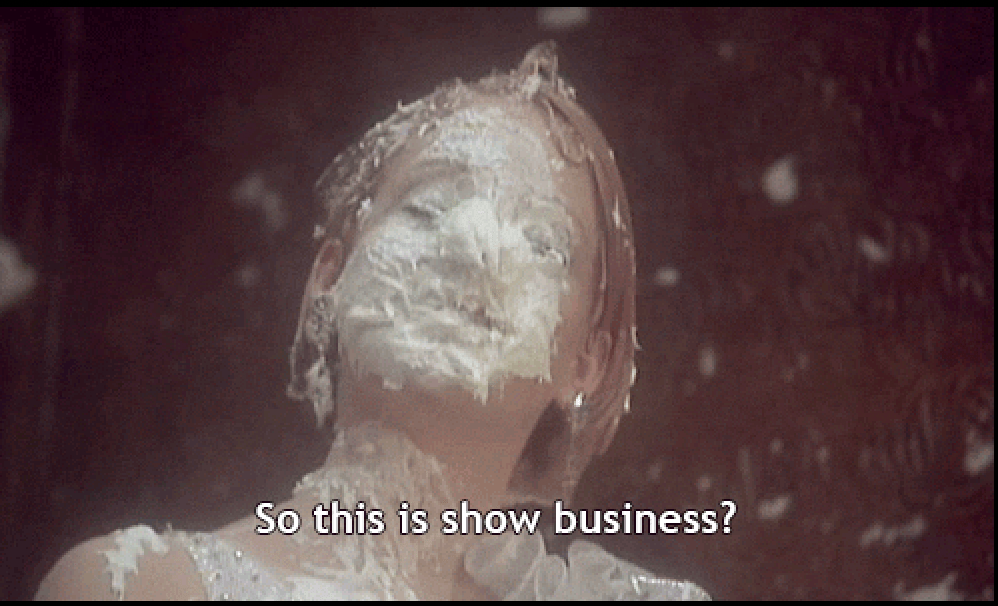
The casting of 12 year-old, Jodie Foster was considered controversial at the time and definitely wouldn’t happen in today’s film industry. Foster is incredibly positive about her time shooting the movie and I am OBSESSED with the fact that she came straight off the set of Taxi Driver, into filming the family-friendly musical comedy, Bugsy Malone. Imagine one day you’re getting notes from Martin Scorsese and the next day you’re singing ‘We Could Have Been Anything That We Wanted To Be’ with a pie splashed across your face.
Taxi Driver became the prototype for lots of late-night films about the dark underbelly of a city. The influence of the cinematography can be seen in any film where there is a curb crawling shot of a street lit up by neon lights and seedy bars. The stories and themes of the film have been copied and reused with varying degrees of success, check out my thoughts on 1985’s, Streetwalkin’ for more on that as I am sure that was directly inspired by some of the stylistic choices of Taxi Driver. For me as a late-night consumer, I like the infinite feel of a story told at night, that there are things that only move in the dark. I will most definitely be watching the rest of Paul Schrader’s ‘Night Worker’ films so keep an eye out for my thoughts on those in the coming months!
MIDNIGHT BONUS: Taxi Driver is one of those classic films that I often follow with a Gordon Ramsay chaser, and for more about that, check out my Kitchen Nightmares post.
 Midnight Culture